
The IATA Operational Safety Audit (IOSA Audit) is a benchmark for airline operational safety. When auditors identify issues, they document them in a structured way to guide corrective actions and manage risk. Understanding how IOSA Audit findings are defined and handled helps operators respond proportionately, satisfy regulatory expectations, and maintain IOSA registry status. This article explains how findings and observations are used in IOSA audits, links the concept to international safety expectations, and offers practical steps teams can apply during preparation, response, and close-out. The emphasis is on clear, structured action that supports both compliance and continuous safety improvement.
Understanding IOSA Audit findings
IOSA follows the IATA Standards and Recommended Practices (ISARPs) and is conducted in accordance with the IOSA Audit Programme Manual (IAPM). The programme aligns with ICAO safety principles, particularly those related to organisational accountability and systematic safety oversight, but it applies its own specific audit terminology.
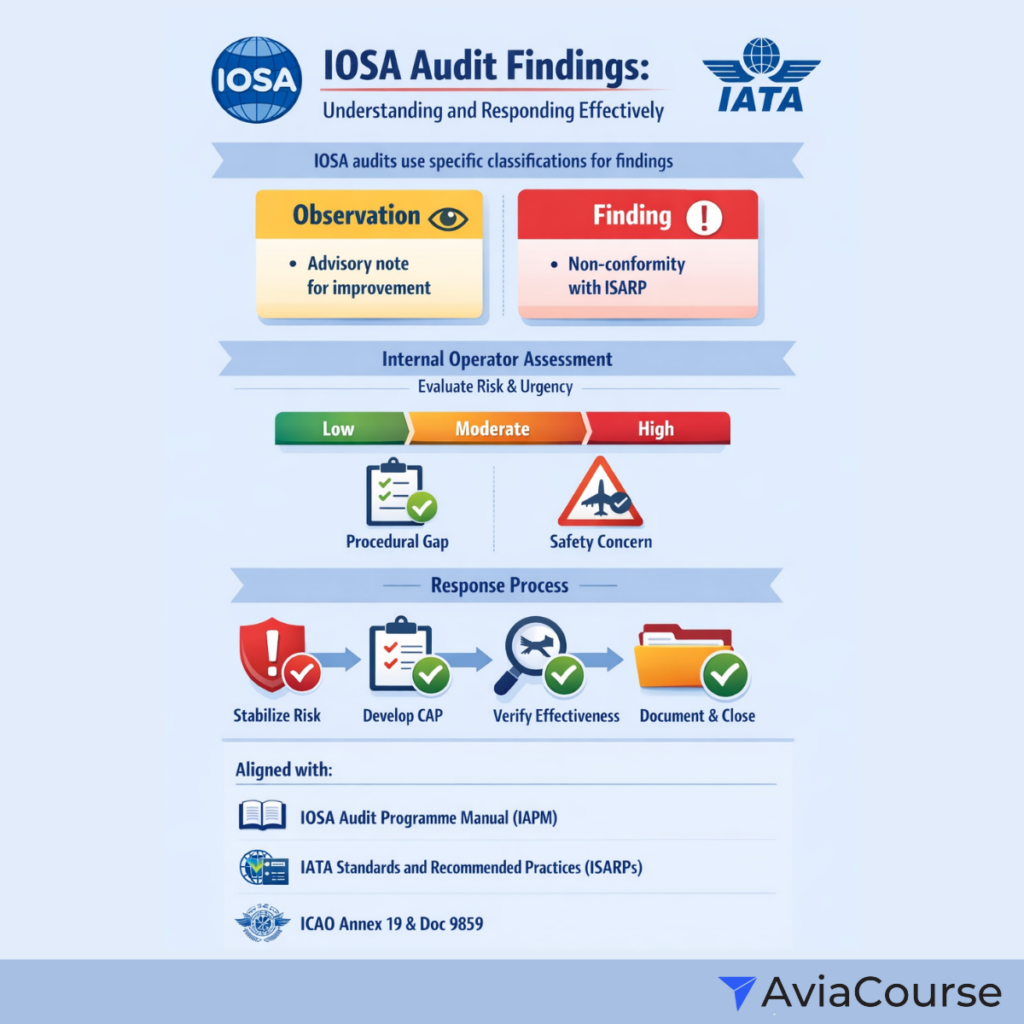
Under the IOSA Audit Programme, audit outcomes are recorded as either Findings or Observations.
An Observation identifies a condition that does not fully meet the intent of an ISARP but does not constitute a non-conformity. Observations are advisory in nature and are intended to support continuous improvement and early correction before safety performance is affected.
A Finding represents a non-conformity with an ISARP. All findings require corrective action and formal closure through the IOSA process in order to maintain IOSA registration. IOSA does not formally categorise findings by severity (such as minor, major, or critical); within the programme, any non-conformity is considered significant and must be addressed.
In practice, many operators assess IOSA findings internally using their Safety Management System (SMS). This internal assessment helps determine the urgency and priority of response based on safety risk. Some findings may reflect limited procedural gaps, while others may indicate systemic weaknesses or increased operational risk requiring immediate mitigation. While IOSA itself does not apply severity labels, effective operators consistently link the risk associated with a finding to the speed and robustness of corrective action, in line with ICAO SMS principles.
Practical steps to prevent, respond to, and close findings
Preparation is the most effective way to reduce the number and impact of IOSA Audit findings. Operators should maintain up-to-date manuals, documented processes, and training records; conduct regular internal audits aligned with IOSA scope; and use their SMS to identify trends and weaknesses before an external audit.
When a finding or observation is raised, a structured response cycle should be followed: clearly record the issue, assess the associated safety risk, implement immediate mitigations where necessary, develop a corrective action plan (CAP) with defined owners and timelines, verify effectiveness, and retain objective evidence for closure in accordance with IOSA requirements.
Immediate priorities for handling findings can be summarised as follows:
- stabilise safety risk
- notify relevant stakeholders
- document actions taken
- assign corrective action owners
- track evidence for verification
When developing a CAP, clarity is essential. Define what will change, who is responsible for implementation, the completion date, and how effectiveness will be measured. Root-cause analysis techniques such as the 5 Whys or fishbone analysis help ensure corrective actions address underlying causes rather than symptoms. Where a finding indicates elevated safety risk, interim mitigations (for example, additional oversight, temporary procedural controls, or focused training) should be implemented while permanent corrective actions are developed. Communication with the auditor, and where required with the civil aviation authority, should be transparent and well documented. All actions and evidence should be maintained in a centralised system to support audit close-out.
Integrating lessons learned
Close-out is not merely an administrative step; it is confirmation that corrective actions have effectively removed the risk and reduced the likelihood of recurrence. Lessons learned should be integrated into daily operations and monitored through the SMS. Trend monitoring and internal assurance activities help ensure similar issues do not reappear in other areas of the organisation. Clear documentation, objective evidence, and demonstrable improvement support both IOSA closure and long-term safety performance.
Conclusion
Clear understanding of how IOSA Audit findings and observations are defined enables organisations to respond proportionately and protect safety while meeting audit expectations. Preparation through internal audits and robust documentation, structured corrective actions supported by root-cause analysis, and verification through objective evidence and SMS monitoring all contribute to successful IOSA outcomes. Consistent application of these practices supports IOSA registration and strengthens safety culture across the operation.


Comments Off on IOSA Audit: 5 Priorities for Effective Corrective Action