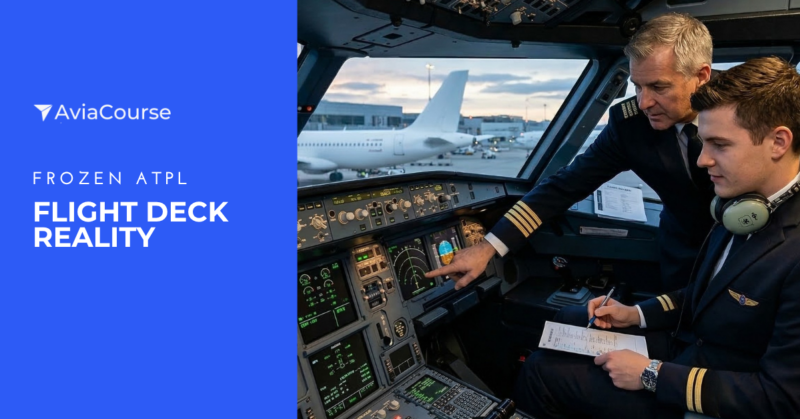
Earning an ATPL theory credit (Frozen ATPL) and stepping into airline operations are not the same milestone. For many newly qualified pilots, the real transition begins after the licence exams, when technical knowledge must be converted into consistent, standardized performance in a multi-crew, highly regulated environment.
Airlines do not expect a new First Officer with a frozen ATPL to arrive as a finished captain-in-waiting. However, they do expect a reliable professional who can learn quickly, operate within procedures, and contribute to a safe flight deck culture from day one. Success at the airline entry level is less about showing brilliance and more about demonstrating disciplined competence. The gap between ATPL study and real airline operations is where many aviation careers are shaped.
Understanding what operators actually assess can make the transition from ATPL graduate to airline pilot far more efficient and far less stressful.
Airline standards begin with SOP discipline, not individual style
New First Officers are normally recruited with a frozen ATPL, but airlines evaluate them based on operational behavior rather than academic knowledge alone.
Under international frameworks such as ICAO Annex 1 for personnel licensing and ICAO Annex 6 for aircraft operations, along with regional requirements like EASA Air OPS and Part-FCL, airline environments are built on standardization, recurrent training, and documented competence. This means a pilot entering airline training with an ATPL background must adapt to an operational system rather than improvise around it.
In practice, airlines first look for SOP compliance. A new First Officer must be able to fly accurately, brief clearly, manage automation properly, and respect callout discipline. Technical handling still matters, especially during raw-data segments, abnormal scenarios, and high-workload phases such as departure, approach, and go-around. However, many training captains are more concerned about procedural drift than small imperfections in manual flying. An FO who is stable, methodical, and coachable is often more valuable than one who is confident but inconsistent.
Operators also expect a working understanding of Threat and Error Management (TEM) and Crew Resource Management (CRM). These are not abstract classroom concepts learned during ATPL training. They appear in every sector through task sharing, cross-checking, situational awareness, and challenge-response communication.
A new First Officer should know when to speak up, how to monitor effectively, and how to avoid becoming passive in a command-led cockpit. The modern airline pilot is assessed as part of a crew system, not as a solo performer.
Another key expectation is disciplined preparation. Before reporting for type rating or base training, candidates should already be comfortable with:
-
performance fundamentals
-
IFR procedures
-
weather interpretation
-
operational documentation
-
airline operational terminology
Even when the airline provides full conversion training after ATPL qualification, self-study habits signal professionalism.
Training departments quickly notice whether a pilot arrives prepared, or expects to be taught everything from zero.
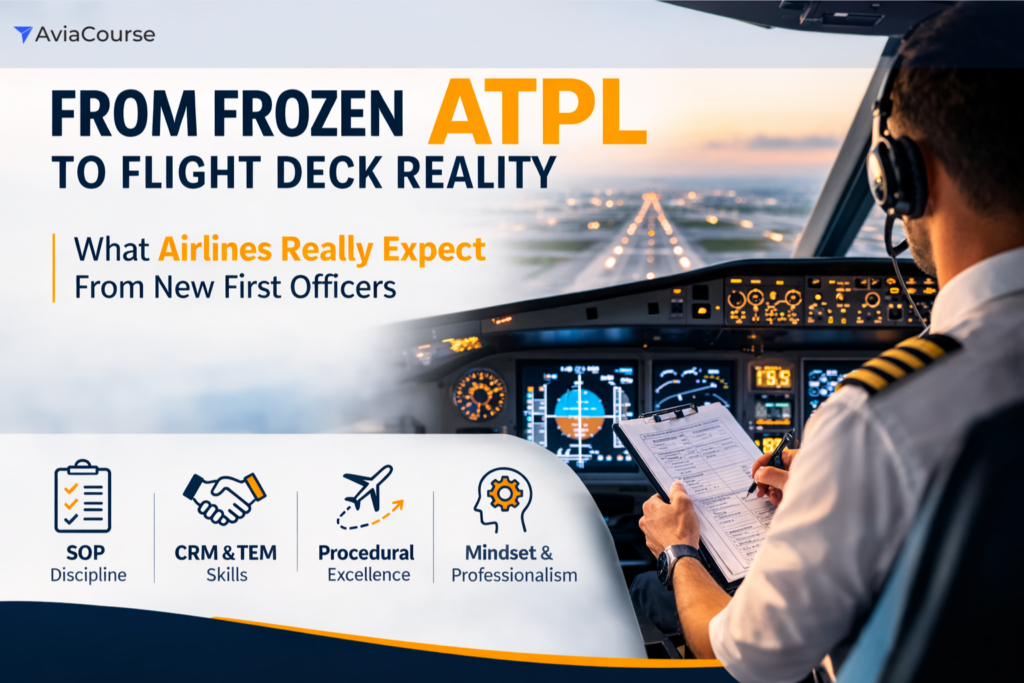
What training departments actually watch during type rating and line training
Once a pilot enters airline training after obtaining their ATPL theory credit, expectations become more specific.
During type rating, line-oriented simulator sessions, and supervised line flying, instructors usually monitor four core areas:
-
technical handling
-
procedural compliance
-
cognitive capacity
-
interpersonal behaviour
These areas align closely with competency-based training principles promoted by ICAO, which many airlines now integrate into their training systems.
Technical handling is the most visible area, but it rarely decides success alone. A new First Officer is expected to maintain flight path control, understand energy management, and use automation deliberately rather than dependently.
Instructors will observe:
-
mode awareness
-
anticipation of aircraft response
-
avoidance of “button pushing without thinking”
Manual flying skills remain important for pilots with Frozen ATPL, yet strong automation management is equally critical in transport-category aircraft.
Procedural compliance is often the strongest predictor of successful line integration. Airlines need pilots who can absorb flows, checklist philosophy, briefing structures, and abnormal procedures without creating confusion on the flight deck. This is particularly important because airline operations are conducted under an approved Operations Manual system. A First Officer is not only learning an aircraft. They are learning how that operator flies the aircraft within regulatory approval and company policy.
Cognitive capacity refers to workload management and decision-making under pressure. A new FO with an ATPL background is not expected to demonstrate captain-level judgement, but they must prioritize correctly, recognize deteriorating situations early, and avoid fixation.
Transport aircraft operations require pilots to stay ahead of the aircraft while processing ATC instructions, monitoring trajectory, and maintaining situational awareness. Pilots who can verbalise priorities and request support when overloaded usually perform better than those trying to appear effortlessly capable.
Interpersonal behavior is another critical area.
Instructors and line captains pay close attention to:
-
receptiveness to feedback
-
cockpit humility
-
communication style
-
professionalism
Professionalism includes punctuality, document discipline, fatigue awareness, and the willingness to admit uncertainty early.
In a safety-sensitive industry, defensiveness creates training risk. Coachability is an operational asset.
The mindset shift from licence holder to airline professional
The most important change from frozen ATPL to effective First Officer is psychological. During ab initio training, progress is often measured by passing checks. In airline operations, progress is measured by repeatable safety performance. The best new FOs understand that competence means being predictable, standardised, and dependable across ordinary sectors, disrupted operations, and training events. Airlines want pilots who reduce variability, not pilots who create a personal style too early.
This mindset also includes respect for the operator’s safety culture. Whether under EASA, UK CAA, FAA, or another national authority aligned with ICAO standards, airlines increasingly train within competency frameworks linked to reporting culture, just culture, and data-informed oversight. A new First Officer should therefore view reporting, debriefing, and error discussion as normal professional behaviours. Silence, concealment, or image management have no place in a mature airline environment.
There is also a commercial reality worth understanding. Airlines need First Officers who can be integrated efficiently into rosters, recurrent training cycles, and line operations without creating unnecessary training drag. That does not mean perfection is expected. It means consistency, preparation, and adaptability are expected. New pilots who arrive with strong fundamentals, procedural discipline, and a collaborative attitude usually progress faster than those focused only on technical flair.
For aspiring airline pilots, the message is practical. Build your manual flying and instrument discipline, but invest equally in SOP thinking, CRM behaviour, and automation literacy. Treat every simulator session as a rehearsal for standardised airline operations, not as an opportunity to impress. And learn to receive feedback as operational data, not as personal criticism. Those habits are what training captains remember when they decide whether a new First Officer is ready for the line.
The transition from frozen ATPL to airline flying becomes smoother when you stop asking, “How do I pass the next check?” and start asking, “How do I become easy to trust on the flight deck?” Focus on standardisation, preparation, and crew integration before type rating begins. If you can combine technical competence with disciplined professionalism, you will match far more closely what airlines actually expect from a new First Officer.


Comments Off on From Frozen ATPL to Flight Deck Reality: What Airlines Really Expect From New First Officers