
Flight Data Monitoring under EASA is becoming one of the most valuable tools for modern aviation safety management. By turning routine flight recordings into actionable operational insight, Flight Data Monitoring (FDM) helps operators identify risks early, detect trends, and prevent incidents before they occur. Under EASA oversight, Flight Data Monitoring under EASA is not simply a technical requirement. It is a proactive safety programme designed to strengthen decision-making, enhance training, and support continuous improvement within an operator’s Safety Management System (SMS).
This article explains what regulators expect, how to build an effective Flight Data Monitoring under EASA programme, and how to integrate results into training and risk management. The guidance is intended for operators, safety managers, instructors, and compliance personnel seeking practical and sustainable implementation steps.
What Flight Data Monitoring under EASA Means for Operators
Flight Data Monitoring under EASA involves collecting and analysing data from flight data recorders (FDR) and quick access recorders (QAR). The goal is to monitor operational performance and detect deviations that may indicate safety exposures. EASA frames Flight Data Monitoring under EASA as a key element of proactive safety oversight. Rather than reacting only after incidents, operators are expected to use FDM to understand how flights are actually being conducted in daily operations.
Importantly, the intention is not to capture every minor deviation. Instead, the program should focus on events, exceedances, or behavioral trends that have real safety significance.
In practice, operators must document:
-
Programme objectives
-
Event definitions and thresholds
-
Processes for analysis and review
-
Integration into SMS decision-making
International standards, including ICAO safety management frameworks, align with this risk-based approach.
How to Set Up an Effective Flight Data Monitoring under EASA Programme
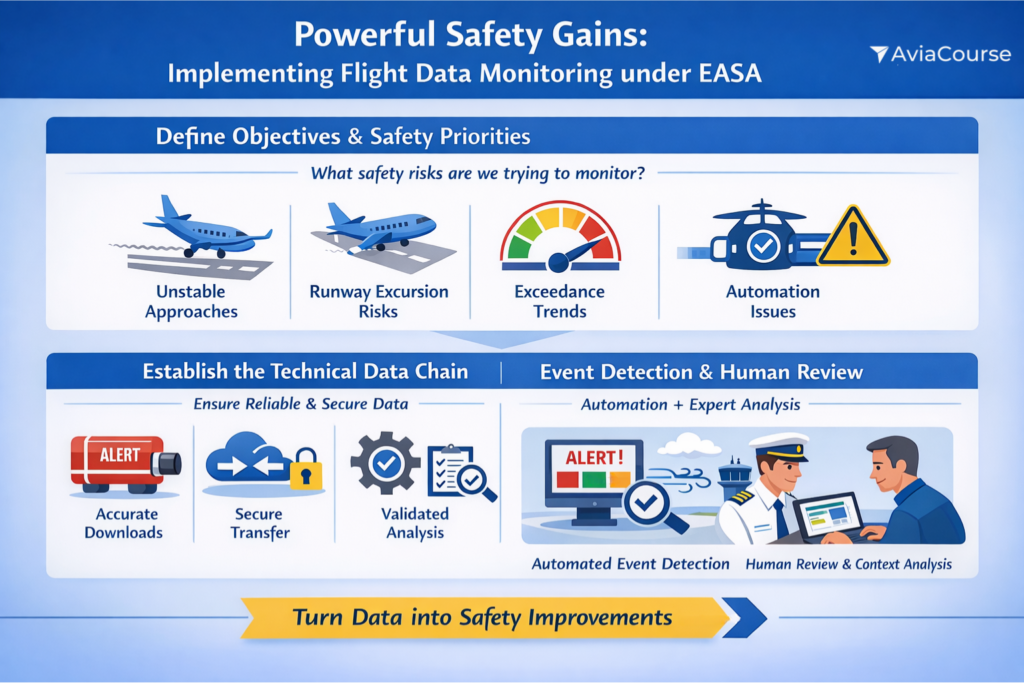
A successful Flight Data Monitoring under EASA programme starts with clear and realistic objectives.Ask: What safety risks are we trying to monitor, and what decisions will the data support?
Define Objectives and Safety Priorities
Begin by linking FDM goals directly to your SMS. Common priorities include:
-
Unstable approaches
-
Runway excursion risks
-
Exceedance trends
-
Automation management issues
Starting small with a few high-impact risks makes implementation manageable.
Establish the Technical Data Chain
Reliable data capture is essential. Operators must ensure:
-
Accurate recorder downloads
-
Secure data transfer
-
Validated processing tools
-
Quality checks to avoid false positives
Without data integrity, Flight Data Monitoring under EASA loses credibility and operational value.
Event Detection and Human Review
Automated software can detect events quickly, but human expertise is critical for context.
For example, an exceedance may reflect weather, ATC constraints, or operational necessity rather than unsafe behaviour.
A combination of automation and expert review ensures meaningful conclusions.
Data protection, legal issues and operational integration
Protecting crew confidentiality and complying with data protection laws is essential. EASA guidance stresses privacy safeguards and the promotion of a just culture that focuses on systems and learning rather than punishment. In the EU context, operators must consider GDPR requirements when handling personally identifiable data and implement processes for anonymisation or restricted access where appropriate. Integrate FDM outputs with your existing safety processes: feed findings into safety meetings, occurrence reporting reviews, and training syllabi. Ensure instructors and examiners understand how FDM evidence informs recurrent training and proficiency checks, and maintain transparent communication with crews about the programme’s objectives and protections.
Successful FDM is practical, iterative, and integrated. Start small with clear priorities, validate detections before acting, and build trust through confidentiality and transparent use of data. Use FDM to inform targeted training and operational risk controls rather than as a stand-alone surveillance measure.
Conclusion
Implement a focused FDM programme by defining clear objectives, validating data and detections, and integrating findings into training and the SMS. Protect privacy and support a just culture to maintain crew trust and programme effectiveness. Regularly measure outcomes to demonstrate risk reduction and refine thresholds and mitigations.
Flight Data Monitoring (FDM) in Airline Operations — A detailed page about the FDM training offered by AviaCourse, including objectives, regulatory context, analysis techniques and safety applications.
Further reading: DEVELOPING STANDARDISED FDM-BASED INDICATORS


Comments Off on Powerful Safety Gains: Implementing Flight Data Monitoring under EASA